
The ignition sequence of a four-cylinder gasoline engine is either 1243 or 1342. This is because cylinders 1 and 4, as well as 2 and 3, are in the same position. In this context, “the same position” refers to both the top and bottom positions, with a difference of two strokes between them. Downward movement, compression, and exhaust constitute upward movements. Essentially, each cylinder undergoes four strokes, and it is impossible for them to be in the same stroke simultaneously during operation. The following sections will introduce the valve clearance adjustment method and detailed ignition steps of the four-cylinder diesel engine.
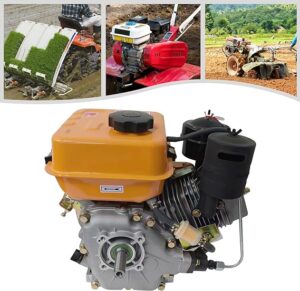
Working Principle of Diesel Engine
Intake Stroke
During the intake stroke, the working medium entering the cylinder is pure air. Due to the low resistance of the diesel engine intake system, the intake end pressure (pa) ranges from 0.85 to 0.95 times the ambient pressure (p0), which is higher than that of a gasoline engine. The end-point temperature of intake air (Ta) is between 300K and 340K, which is lower than that of a gasoline engine.
Compression Stroke
As the compressed working medium consists of pure air, the compression ratio of a diesel engine is higher than that of a gasoline engine, typically ranging from 16 to 22. The pressure at the end of compression ranges from 3000 to 5000 kPa, and the temperature at the end of compression ranges from 750K to 1000K, greatly exceeding the autoignition temperature of diesel (approximately 520K).
Working Stroke
As the compression stroke nears its end, diesel fuel is injected into the cylinder combustion chamber at high pressure (approximately 10 MPa) by the high-pressure oil pump, through the injector. This injection is brief and results in spontaneous ignition and combustion once the fuel mixes with air within a certain period. The pressure of the gas in the cylinder rises rapidly, reaching highs of 5000 to 9000 kPa, with temperatures peaking between 1800K and 2000K. Diesel engines are known as compression ignition engines because they ignite and burn spontaneously.
Exhaust Stroke
The exhaust process in a diesel engine is essentially similar to that of a gasoline engine, although the exhaust temperature is lower, typically ranging from 700K to 900K. In a single-cylinder engine, uneven rotational speed, unstable engine operation, and significant vibration are common issues. This is because only one of the four strokes generates power, while the other three strokes consume power to prepare for work. To address this, the flywheel must possess sufficient moment of inertia, leading to an increase in the overall engine mass and size. Multi-cylinder engines help mitigate these shortcomings.
Diesel Ignition Sequence
Three-Cylinder Diesel Engine: 1-3-2
Inline Four-Cylinder Diesel: 1-2-4-3 or 1-3-4-2
Inline Five-Cylinder Diesel: 1-2-4-5-3
In-line Six-Cylinder Diesel Engine: 1-5-3-6-2-4 or 1-4-2-6-3-5
V-type Six-Cylinder Diesel Engine: Cylinder sequence: Right to back: 1-3-5; Left to front to back: 2-4-6. Ignition sequence: Generally 1-4-5-2-3-6.
V-type Eight-Cylinder Diesel Engine: 1-8-4-3-6-5-7-2
Diesel Engine Valve Clearance Adjustment Method
Four-Cylinder Diesel Engine (working sequence: 1-3-4-2)
Method 1:
- Open the cylinder cover and turn the crankshaft twice.
- Observe the valve movement of the 4-cylinder engine. When the intake and exhaust valves overlap, it is the exhaust top dead center of the 4-cylinder.
- At this point, cylinder 1 is at the top dead center of compression. Adjust the intake and exhaust valves of cylinder 1, the intake valve of cylinder 2, and the exhaust valve of cylinder 3, as these valves are completely closed.
- Turn the crankshaft 360 degrees to find the compression top dead center of the 4-cylinder, and adjust the remaining valves.
Method 2:
When adjusting the 4-cylinder engine according to the “1 double, 2 in, 3 row, 4 no” sequence at the compression top dead center of the 1 cylinder, adjust the valve clearance by the valve that is completely closed inside.
Six-Cylinder Diesel Engine (power sequence: 1-5-3-6-2-4)
Method 1:
- Open the cylinder cover and observe the valve movement of the 6-cylinder engine.
- When the intake and exhaust valves overlap, it is the exhaust top dead center of the 6th cylinder. At this point, cylinder 1 is at the compression top dead center. Adjust the intake and exhaust valves of cylinder 1, the intake valve of cylinder 2, and the exhaust valve of cylinder 5, as these valves are completely closed.
- Turn the crankshaft 360 degrees to find the compression top dead center of the 6-cylinder, and adjust the remaining valves.
Method 2:
When adjusting the 6-cylinder engine according to the “1 double, 2 in, 3 row, 4 in, 5 row, 6 no” sequence at the compression top dead center of the 1 cylinder, adjust the valve clearance using the valve that is completely closed inside.