1. Types of High-Gloss Photo Paper
1. High-Gloss Inkjet Printing Photo Paper
This type uses an RC (plastic-coated) paper base, ideal for image outputs with vibrant colors and photographic effects. It offers high resolution, generally above 720 dpi, producing clear, bright images with good gloss. It also has excellent light and color fastness, making it suitable for indoor displays. It’s typically paired with high-end inkjet printers.
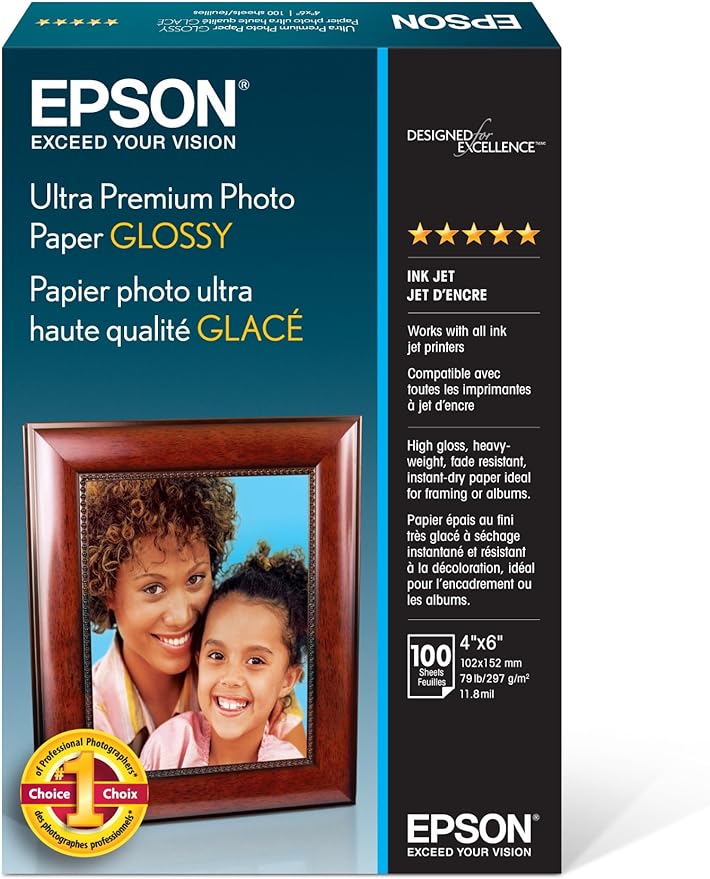
Epson Ultra Premium Photo Paper Glossy – S042174, 4″ x 6″ (100 sheets),White, Check The Price >>>
2. Matte Inkjet Paper
Matte inkjet paper also features an RC paper base with a medium gloss finish. It supports high-resolution printing and produces photographic-quality images with bright, rich colors. It offers good light fastness as well.
3. Special Inkjet Printing Paper
This paper also uses an RC base but includes fluorescent agents and magnetic materials, offering anti-counterfeiting and anti-copying features. It provides ultraviolet resistance and excellent light fastness, making it suitable for special projects requiring photographic effects and added security features.
4. PVC Inkjet Paper
Made from a composite of plastic film and paper, this type boasts good mechanical strength, high-quality image output, and excellent ink absorption. It offers strong indoor light resistance and is perfect for high-quality photographic outputs.
5. High-Gloss Inkjet Paper
This paper uses a thicker base with a photo-like glossy finish. It offers high ink absorption and is particularly suitable for photo image outputs and advertising displays. The resulting images are rich in detail and full of vibrant colors.
2. Differences Between High-Gloss Photo Paper and RC Photo Paper
1. Substrate
Both types use a plastic-coated photo paper base. If a cast-coated high-gloss photo paper also uses a coated paper backing, it can be referred to as RC cast-coated high-gloss photo paper.
2. Gloss
The gloss on cast-coated high-gloss photo paper is mainly influenced by the casting cylinder, with factors like cylinder finish, temperature, and pressure affecting the final result. In contrast, RC high-gloss photo paper derives its gloss from the resin itself and isn’t impacted by external factors.
3. Print Drying Speed
The drying speeds of both types are essentially the same.
4. Color Reproduction
Both offer similar color reproduction quality.
5. Coating Process
RC high-gloss photo paper is produced via a multi-stage extrusion coating machine, involving three to four wet coatings. This process is faster but more complex. In contrast, cast-coated high-gloss photo paper is produced using simpler equipment with one or two coatings at a slower speed.
6. Usage
Both papers can effectively reproduce true image colors, making it difficult for non-professionals to distinguish between the two. For professional settings (e.g., photo studios), there may be minor differences in use value.
3. Characteristics of High-Gloss Photo Paper
- High-gloss photo paper produces vibrant images with better quality than ordinary PVC rigid sheets or PP synthetic papers.
- It is thicker than typical PVC sheets and PP synthetic papers, with a thickness of around 220-230 microns, compared to 160-180 microns for PVC sheets and 180 microns for PP synthetic paper. This gives it superior durability.
- High-gloss photo paper can withstand high temperatures and can be processed using a high-temperature strengthening furnace.
- Its cost is lower compared to PVC rigid sheets and waterproof PP, with prices typically under 3 yuan per square meter.
4. How to Assess the Quality of High-Gloss Photo Paper and Prints
1. Highlights
The white and bright areas of the scene should appear as neutral points with minimal density on the print, retaining the original scene details. The quality of these highlights depends on color balance, contrast, density, fog levels of the paper and film, contamination, and proper handling during and after processing.
2. Shaded Areas
Dark or high-density areas should be neutral in tone and slightly lower in density than the maximum. These areas should retain the original details of the scene. Factors like exposure, density, color balance, and processing conditions impact the appearance of shadows.
3. Color Saturation
The colors in the print should appear fresh, transparent, and well-saturated without appearing cloudy or dull. Accurate color restoration depends on factors like film exposure, proper development, and contamination during processing.
4. Colors
Good prints should faithfully reproduce the colors of the original scene, particularly “memory colors” like the blue sky, green trees, and skin tones. These colors are easy to recognize, even with small deviations, so maintaining color balance is crucial. Neutral gray areas are particularly sensitive to imbalances, and the quality of reproduction is influenced by the light source, printer settings, and development process.
5. Contrast
The contrast levels in a print should be balanced across all image layers. Mismatched contrast in different color-sensitive layers can lead to unnatural color casts. Proper film preservation, contamination control, and correct development are essential for maintaining balanced contrast.
6. Density
The light and dark areas of a scene should be accurately represented in the print, with the appropriate density for each area. Density levels are influenced by camera and printer exposure settings as well as the development process.