
Victrola Nostalgic 6-in-1 Bluetooth Record Player
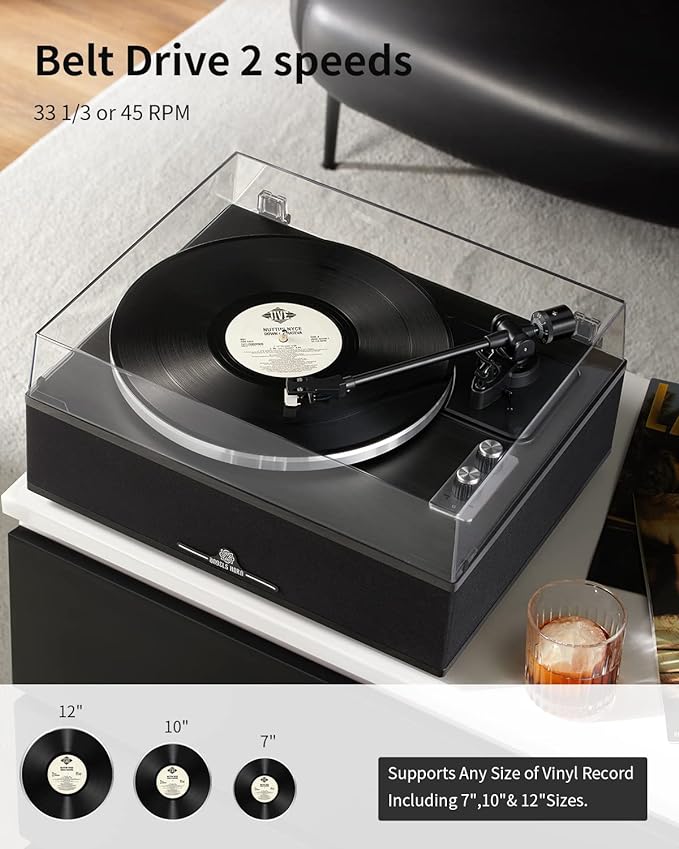
The phonograph, also known as the record player, is an original playback device. The structure of the record player can be simply divided into four parts: a turntable, a loudspeaker, a tone arm, and a cartridge. The principle of the record player’s sound is that when the record rotates, the grooves on the record cause the needle to vibrate and produce sound. Who invented the phonograph? Is there a difference between a record player and a CD player? How do you use a vinyl record player? Let’s explore the encyclopedia of gramophone knowledge!
What is a Phonograph?
Definition: A phonograph is an electrical device used to play recordings on records, also known as a record player, where sound is stored in an acoustic method in an arc-shaped groove carved into the surface of the record (disk). The record is placed on a turntable and rotated under the needle to produce sound.
Types of Phonographs: Phonographs are mainly distinguished by their shape. While they differ little in principle and function, they can be roughly categorized into cassette phonographs, desktop phonographs, vertical phonographs, cabinet phonographs, etc.
Functions of a Phonograph: In addition to being used for audio and music playback, phonographs are also used for interior decoration, gift-giving, art collection, and other purposes.
Gramophone Structure
- Turntable: The phonograph turntable is used to place the record and rotates it so that the stylus can read the analog signal on the vinyl record and produce sound.
- Loudspeaker: The large speaker amplifies the sound read by the stylus, which is very faint, particularly in higher pitches.
- Tone Arm: The tone arm has a cartridge at the front and a gyration device at the back. Most modern phonographs include an automatic tone arm retraction feature, which lifts the tonearm and stops the turntable after the record finishes playing.
- Cartridge: The cartridge’s main component is the stylus, which converts the analog signal from the stylus into vibrations. These vibrations are transmitted to a special membrane, which reproduces the sound wave pressure, turns it into sound, and then amplifies it through the large speaker.
Principle of the Phonograph
The phonograph automatically produces sound because the stylus senses the grooves on the record. To make the phonograph produce sound, a special record must be placed on it. As the record is produced, the varying audio strength leaves different traces on the record. Placing the record on the turntable of the phonograph allows the stylus to sense these grooves. The current is induced through the coil, and the amplifier enhances the sound.
Who Invented the Phonograph?
The inventor of the phonograph is generally considered to be Thomas Alva Edison. On November 21, 1877, the American inventor announced the invention of the first phonograph—a device for recording and reproducing sound. Edison’s patent was granted on the 19th.
Before Edison, a few individuals contributed to the invention of the phonograph. The first phonograph recording device was the sonic vibrometer, invented by the Frenchman Scott-de-Martinville. It could transcribe sound into a visual medium but couldn’t play it back. In 1877, French scientist Charles Cros proposed a phonograph principle, although he did not create a model. His principle was submitted to the French Academy of Sciences and published in December 1877. By then, Edison had already developed a model, thus Edison is credited with inventing the phonograph.
Difference Between a Record Player and a CD Player
- Different Structure:
- The vinyl record player consists of a base, turntable, tone arm, and cartridge.
- A CD player primarily includes a laser pickup, turntable system, servo system, signal processing system, information storage system, and control system.
- Different Principles:
- The vinyl record player produces sound by translating the sound into an electrical signal and a mechanical signal from the disc texture.
- The CD player produces sound by digital sampling, recording the digital signal, decoding the digital signal, and then simulating the sound signal.
- Different Sound Quality Effects:
- Vinyl record players generally produce more realistic and warmer sound than CD players, although the sound may be slightly less clear.
- Price Difference:
- Vinyl record players range in price from a few hundred to tens of thousands of yuan. Higher quality players typically cost several thousand yuan, much more expensive than a CD player of equivalent quality.
How to Choose a Phonograph
- Consider Sound Quality:
- Sound quality depends on stylus type and rotational speed. For beginners, a durable round stylus is recommended. Audiophiles might prefer an oval or super oval stylus with a finer tip.
- Consider Production Process:
- Phonographs are produced as all-in-one or independent models. All-in-one models are easier to connect and use, whereas independent models are more professional and require connections to power amplifiers or active speakers for sound playback.
- Consider Playback Method:
- Most phonographs feature manual operation, with some offering automatic playback. Beginners typically opt for automatic models for ease of use.
How to Use a Vinyl Record Player
- Place your favorite vinyl record on the turntable.
- Remove the cartridge cover and unlock the tonearm.
- Gently place the tonearm stylus on the record to start playback.
- The tonearm will automatically retract and the record will stop rotating after it finishes playing.
- To stop playback, lift the tonearm and return it to the tonearm slot. Repeat this process to repeat the music.
External Audio Requirements
Whether a vinyl record player requires external audio depends on its production process:
- All-in-one production models do not require external speakers or power amplifiers.
- Independently produced models are designed for professionals and require connections to power amplifiers or active speakers for sound playback.
Gramophone FAQ
Troubleshooting and Repair:
- Phonograph Turntable Does Not Rotate:
- Remove the central locking piece and check the drive belt.
- Ensure the card switch is in normal contact.
- Check the connection line between the movement and the main board.
- Phonograph Playback is Distorted:
- Check for scratches on the turntable.
- Ensure the three-speed transfer switch is correctly selected.
- Verify the stylus is correctly positioned.
- Skipping Needles During Playback:
- Check the record track for scratches.
- Replace the stylus if necessary.
Tuning the Phonograph for Noise:
- Check the record for quality issues like scratches.
- Clean or replace the record.
- Adjust the phonograph to resolve noise issues caused by audio, wire, or radio frequency interference.
Care and Maintenance of Classical Gramophones:
- Avoid direct sunlight exposure to prevent fading and damage to the wood and plastic parts.
- Use a dry cotton rag and fine soft brush to remove dust and avoid using water or solvents on stains.
- Prevent moisture damage by maintaining indoor humidity levels.
- Remove yellowing with toothpaste and tea, and prevent cracking by controlling indoor humidity.