
Bimetal Thermometer
The Bimetal Thermometer serves as a field detection instrument for measuring medium and low temperatures. It directly measures the temperature of liquid vapor and gas mediums within the range of -80℃ to +500℃ in various production processes. The key component of an industrial bimetal thermometer is a multi-layered metal sheet composed of two or more stacked metal sheets. It operates on the principle that two different metals expand differently with temperature changes. The bimetallic sheet is wound into a circular curved shape, and as one end is heated and expands, it drives the pointer to rotate, displaying the temperature value corresponding to the thermoelectric potential on the working instrument.
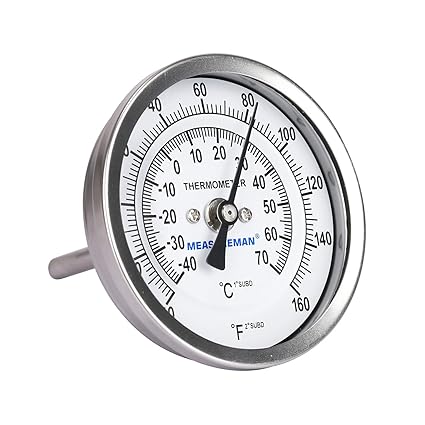
Product Overview
The WSS series bimetal thermometer functions as a field detection instrument for measuring medium and low temperatures. It directly measures the temperature of liquid, steam, and gas mediums within the range of -80℃ to +500℃ in various production processes.
Principle Structure
A bimetal thermometer employs a threaded thermal bimetallic sheet as a temperature sensing device, installed within a protective sleeve. One end is fixed, termed the fixed end, while the other end is the free end connected to a thin shaft. A pointer is mounted on the free end spool. When the temperature changes, the free end of the temperature sensing device rotates accordingly, driving the pointer to change the angle, indicating the corresponding temperature on the dial.
Selection Notes
Classification Based on the connection between the bimetal thermometer dial and the protective tube, it can be categorized into four types: axial, radial, 135° directional, and universal.
- Axial bimetal thermometer: Vertical connection of the pointer plate with the protection tube.
- Radial bimetal thermometer: Parallel connection of the pointer plate with the protection tube.
- 135° directional bimetal thermometer: Connection of the pointer disc and the protective tube at 135°.
- Universal bimetal thermometer: Adjustable connection angle between the pointer plate and the protection tube.
Fixed Form Various installation and fixed forms are available for different production needs: movable external thread pipe joint, movable internal threaded pipe fittings, fixed threaded fittings, compression threaded fittings, compressed socket flanged fittings, and fixed flanges.
Model Name WSS□□□□——Protection Type
Features
The advantages of bimetallic thermometers include fast response, small size, good linearity, stability, and, in some cases, high-temperature performance.
The thermoelectric potential of a bimetal thermometer is related to the thermoelectric properties of the hot electrode material and the temperature difference between the two ends. It is highly sensitive, linear, easy to copy, simple in process, and cost-effective.
Common Types
-
Outdoor, Heavy Duty:
- Accuracy class: 1.5
- Time constant: J<40S
- Protection tube withstand voltage: 6.3MPa
-
Electrical Contact Type:
- Accuracy class: 1.5
- Time constant: J<40S
- Protection tube withstand voltage: 6.3MPa
- Contact capacity: Rated power 10VA (non-inductive), maximum voltage: AC 220V, maximum working current: 1A (non-inductive). Contacts are upper and lower limits and are normally open.
- Working temperature of the meter head: -25~55 degrees Celsius
-
Shock-Resistant Electric Contact Bimetal Thermometer:
- Standard: JB/T8803-1998 GB3836-83
- Standard Nominal diameter of dial: 60 100 150
- Accuracy class: (1.0), 1.5
- Thermal response time: ≤40S
- Protection class: IP55
- Angle adjustment error: Not exceeding 1.0% of its range
-
Universal Type:
- Nominal diameter of dial: 100; 150
- Precision grade: 1.0, 1.5
- Connection size: M20x1.5, NPT1/2
- Thermal response time: ≤40s
- Protection class: IP55
-
Integrated Bimetal Thermometer:
- Temperature measurement range: -40~600℃
- Ambient temperature: -10~55℃
- Relative humidity: ≤95%
- Accuracy class: 1.5
- Time constant: ≤60S
- Probe resistance pressure: ≤6Mpa
- Probe diameter: φ8-10mm, movable external thread: M27*2
- Thermal resistance: PT100 (single, dual output) or 4-20mA current output
- Protection class: IP55
Thermowell Type
The thermowell type bimetal thermometer can be paired with various installation casings to meet different pressure level requirements. It directly measures the temperature of liquid, steam, and gas mediums, and solid surfaces within the range of -80 to +500℃ in various production processes.
Installation Requirements
To ensure accurate temperature measurement, safe and convenient maintenance, and uninterrupted equipment operation, the following points should be considered during the installation of bimetal thermometers:
- Select a reasonable position for the measuring point to facilitate sufficient heat exchange with the measured medium.
- Avoid installing the thermometer near the dead ends of valves, elbows, and pipes and equipment.
- Ensure sufficient insertion depth for the bimetal thermometer protection tube to reduce heat transfer and heat dissipation losses.
- For various temperature ranges and fluid types, adjust the insertion depth accordingly.
Use and Maintenance
- Avoid collisions with the protection tube during storage, installation, use, and transportation. Do not bend or deform the protective tube.
- Ensure the instrument operates within the ambient temperature of -30℃ to 80℃.
- Maintain the operating temperature within 1/2 to 3/4 of the scale range.
- The length of the protection tube immersed in the measured medium should be greater than the length of the temperature sensing element.
- Regularly check the thermometer under normal use, approximately every six months.
- Avoid using bimetal thermometers for measuring the temperature of the medium in an open container.
- Charged contact thermometers should not be used in control circuits with large vibrations.